Tuesday, January 01, 2008

The Big New Year's Resolution of 2008

Hello, New Year!

The Reverent Eater was terribly inactive during the latter half of 2007, but we - the royal "we" - have decided to return with a vengeance in 2008! There's so very much work to be done and so much food to be appreciated. Time to get started once again.

I've finally had a sort of mini "vacation" during this week between Christmas and New Year's, which has gifted me with an opportunity to ponder topics of passionate interest OTHER than parish ministry. It's been a lovely break, I must say. And I've used it to think a good deal about - you got it - food.

In particular, I've been researching food and farm policy and reading Animal, Vegetable, Miracle by Barbara Kingsolver. This coming Sunday I'll be preaching on local food systems and sustainable food production...or something like that.

Last night, as I was watching poor ol' Dick Clark count down to 2008, I started to think about meaningful resolutions. Sure, naturally, I want to exercise more like so many of the rest of you. And as usual, I'd like to "eat better," ie., more local foods, more organic foods, fewer processed foods, etc. And I'd like to post more regularly on my blogs. But as I was on my way to bed, I decided on something a lot more concrete, and therefore a lot more challenging.

So here it is...the Big New Year's Resolution of 2008:

I, The Reverent Eater, am going to try very hard...I mean, commit...well, do my best...to not eat any meat products produced in CAFO's for an entire year.

For those of you not familiar with CAFO's...well, where have you been? CAFO's are Concentrated Animal Feeding Operations. These are the gruesome "farm factories," where an overwhelming percentage of our beef, pork, and poultry is produced in the U.S. We're talking feedlots. Cattle, chickens, turkeys, and pigs - which, by the way, are among the most intelligent of mammals - confined to small areas in large numbers.

Here they are fed a mixture of corn - which ruminants in particular have no biological or evolutionary business consuming - and animal by-products. Yes, that means they eat the offal of other cattle, chickens, turkeys and pigs. Well, let me give you the basic list of what your average corn-fed steer eats as Michael Pollan describes it in The Omnivore's Dilemma:

corn flakes, made with GMO corn (genetically modified organism) and grown with petroleum based pesticides

liquified fat, which is often beef tallow

liquified vitamins

synthetic estrogen

antibiotics

some hay and silage for roughage

protein supplements, which may include molasses and urea, which is synthetic nitrogen made from natural gas, feather meal and chicken litter (bedding, feces, bits of feed), chicken meal, fish meal, or pig meal

Appetizing, huh?

CAFO's are cruel to the animals, unhealthy for us people, and massively polluting for our environment.

So, for this year at least, I'm going to give up eating meat whose origins I don't know...which most likely means giving up 85 % of the meat I would regularly eat. No pork stir fries at the Chinese restaurant. No chicken dishes at the Thai or Mexican restaurant. No steak tips at the local Steak House. No burgers or Big Macs or Chicken Sandwiches. Nope. I've got to know the farmer or at least something about the farmer. Otherwise, it's hands off.

Now if you'll excuse me, I've got to get back to my locally grown, organic chicken in my new cast iron dutch oven...

Happy New Year!

Tuesday, February 20, 2007

Food and Books and a Few Short Musings

I just finished reading another food book: Coming Home to Eat: The Pleasures and Politics of Local Foods by Gary Paul Nabhan. It's a book I'd bought over a year ago and which I'd had trouble getting into. I thought this would be the perfect time to try again.

It's similar in many ways to The Omnivore's Dilemma by Michael Pollan, whom I find to be the more accessible writer of the two. Both get into the ills and evils of industrial food production, the craziness of our over-reliance on King Corn, the process and personal moral dilemmas of slaughtering fowl, and the many benefits of eating locally. Nabhan actually does take the reader through a year of his own local eating experiment, which is very interesting and informative. I just had a hard time relating because he lives in Arizona, which is a very different geography and foodshed than my own.

I'd like to write soon about meat-eating and vegetarianism. It's been on my mind a lot since reading Pollan's book and since beginning culinary school. There's a young woman in my class who doesn't seem to be a vegetarian, although she has shown remarkable reluctance to eat animals one might think of as "cute," like bunny and lamb. She also was fairly repulsed by having to clean fish a couple of weeks ago. I'm wondering how she's going to make it through the five weeks of Butchering Seminar that follow Sanitation. Anyway, it's all gotten me thinking...and thinking about writing about my thinking...but I can't do it today, so you'll have to wait a little while longer.

I may also write here more about the Locavore movement - the movement to eat foods grown and produced within 100- (or 150- or 200-) miles of one's home. That is, after all, what Nabhan's book is all about and it is what Pollan comes to see as the most sustainable way of eating. And it's where I'm coming down, too, in terms of my own food ethic. Pollan's book really helped me make more progress in sorting out my own dilemma of whether it's better to eat "organic" or "local." So, more on that, too, coming soon...

Saturday, February 03, 2007

My Other Favorite (Food) Writer

Once again I find myself having great cause to say, "It's been too long." November 23rd was the date of my last post. I left you with a favorite essay from the prolific Wendell Berry on the ethics of eating.

My plan, as of yesterday, was to post some reflections on The Omnivore's Dilemma, written by this ball-capped guy to the left who's holding the piglet. Michael Pollan is his name and he is fast becoming my "other" favorite (food) writer, taking his well-deserved place alongside Wendell Berry. I finished reading TOD this afternoon, having started it only last weekend, and having managed to get through all 400 plus pages of it in only a week. Or, more to the point, I managed to put the book down long enough to actually get done the rest of the things I had to get done this week, which was truly the greater accomplishment, by far.

I've got quite a lot to say about the book and all that it contains, and I still hope to share some of my reflections on it here, since that kind of thing is exactly the sort of thing we do here at The Reverent Eater. But first, it seems appropriate to get back into blogging mode by sharing a quick summary of another more recent piece of Pollan's writing, which is actually reminiscent of the contents of my last post by Wendell Berry. This one is from last Sunday's New York Times Magazine (January 28, 2007) - from an article called "Unhappy Meals," the sort of subtitle to which reads, "Thirty years of nutritional science has made Americans sicker, fatter and less well nourished. A plea for a return to plain old food."

I commend to you the whole article, which I'm sure can be found over at www.nytimes.com. The list that follows is my summary of Michael Pollan's summary of what one might call his own Wendell-Berry-like ethics of eating. So, here we go:

1. "Eat food." By which Pollan means "real food," not processed food products. Or as he explains it, "Don't eat anything your great-great-grandmother wouldn't recognize as food." Which is a lot.

2. "Avoid even those food products that come bearing health claims." Those that claim to be healthy often are not. Instead, they are often highly processed. Don't let what, as Pollan calls it, "the silence of the yams" fool you. Fresh fruits and vegetables are your friends. Even though they don't have highly paid and highly vocal spokespeople.

3. "Especially avoid food products containing ingredients that are a) unfamiliar, b) unpronounceable c) more than five in number - or that contain high fructose corn syrup." 'Nuff said. That's been one of my rules for years.

4. "Get out of the supermarket whenever possible." Or as he says elsewhere in his writings, try to buy food without barcodes.

5. "Pay more, eat less." Good food costs more, no doubt. But you get what you pay for. And even more importantly perhaps, so called "cheap food" carries with it an overwhelming number of hidden costs - oil for transportation, pollution, the devastation of local economies, etc. Besides, Americans used to pay close to 25% of our income on food. Nowadays we pay closer to 10%. Most of us can afford to pay more, and we should - not only for ourselves and our families, but for the welfare of the rest of the world. Oh, and eat less. Yes. We can afford that, too.

6. "Eat mostly plants, especially leaves." If you eat meat, you might be better off thinking of it as a side dish, suggests Pollan.

7. "Eat more like the French. Or the Japanese. Or the Italians. Or the Greeks." As Pollan argues elsewhere, Americans have no consistent food culture of our own, and that gets us in trouble by making us more vulnerable to food fads. In fact, it may matter more HOW we eat than WHAT we eat, which is precisely what an intact food culture would tell us if we had one. "Let culture be your guide," writes Pollan, "not science." Makes good sense to me.

8. "Cook. And if you can, plant a garden." Doesn't this sound like Wendell Berry? In a sentence that this student of the culinary arts deeply appreciates, he writes, "The culture of the kitchen, as embodied in those enduring traditions we call cuisines, contains more wisdom about diet and health than you are apt to find in any nutrition journal or journalism." All the eggs, butter, and cream notwithstanding, I think he's on to something.

9. "Eat like an omnivore. Try to add new species, not just new foods, to your diet." Here he is singing the praises of diversity. To paraphrase Pollan, the greater the variety of the foods we eat, the more likely we are to get all the many and varied nutrients we need.

So, there you have it: Michael Pollan's ethics of eating. Someday soon, I'll share some of my thoughts on The Omnivore's Dilemma. In the meantime, it's time to start reading a new book, which I think will be...Coming Home to Eat: The Pleasures and Politics of Local Foods by Gary Paul Nabhan. (And no, I haven't forgotten that I promised you a summary of Zen Master Dogen's Instructions to the Cook. I'll get to that...don't worry...all in good time...)

Wednesday, October 18, 2006

The Pleasures of Eating

About a year ago, when I debuted as "The Reverent Eater," I began with a quotation from the writings of Wendell Berry. Much to my own surprise, I never returned to him.

Now it is time. For verily, I say unto you, his writing is the fundamental source of my inspiration.

Almost two years ago now, when we moved from the ex-burbs to the city, and as I began to grieve the loss of my capacity to grow my own food - for we'd moved from a 1.11 acre plot to a .11 acre dot - I turned again to the following essay for solace and a sense of the possible. Perhaps you too will find in his words something meaningful and purposeful for your life:

"The Pleasures of Eating" by Wendell Berry

Many times, after I have finished a lecture on the decline of American farming and rural life, someone in the audience has asked, "What can city people do?"

"Eat responsibly," I have usually answered. Of course, I have tried to explain what I meant by that, but afterwards I have invariably felt that there was more to be said than I had been able to say. Now I would like to attempt a better explanation.

I begin with the proposition that eating is an agricultural act. Eating ends the annual drama of the food economy that begins with planting and birth. Most eaters, however, are no longer aware that this is true. They think of food as an agricultural product, perhaps, but they do not think of themselves as participants in agriculture. They think of themselves as "consumers." If they think beyond that, they recognize that they are passive consumers. They buy what they want—or what they have been persuaded to want—within the limits of what they can get. They pay, mostly without protest, what they are charged. And they mostly ignore certain critical questions about the quality and the cost of what they are sold: How fresh is it? How pure or clean is it, how free of dangerous chemicals? How far was it transported, and what did transportation add to the cost? How much did manufacturing or packaging or advertising add to the cost? When the food product has been manufactured or "processed" or "precooked," how has that affected its quality or price or nutritional value?

Most urban shoppers would tell you that food is produced on farms. But most of them do not know what farms, or what kinds of farms, or where the farms are, or what knowledge or skills are involved in farming. They apparently have little doubt that farms will continue to produce, but they do not know how or over what obstacles. For them, then, food is pretty much an abstract idea—something they do not know or imagine—until it appears on the grocery shelf or on the table.

When food, in the minds of eaters, is no longer associated with farming and with the land, then the eaters are suffering a kind of cultural amnesia that is misleading and dangerous. The passive American consumer, sitting down to a meal of pre-prepared or fast food, confronts a platter covered with inert, anonymous substances that have been processed, dyed, breaded, sauced, gravied, ground, pulped, strained, blended, prettified, and sanitized beyond resemblance to any part of any creature that ever lived. The products of nature and agriculture have been made, to all appearances, the products of industry. Both eater and eaten are thus in exile from biological reality. And the result is a kind of solitude, unprecedented in human experience, in which the eater may think of eating as, first, a purely commercial transaction between him and a supplier and then as a purely appetitive transaction between him and his food.

And this peculiar specialization of the act of eating is, again, of obvious benefit to the food industry, which has good reasons to obscure the connection between food and farming. It would not do for the consumer to know that the hamburger she is eating came from a steer who spent much of his life standing deep in his own excrement in a feedlot, helping to pollute the local streams, or that the calf that yielded the veal cutlet on her plate spent its life in a box in which it did not have room to turn around. And, though her sympathy for the slaw might be less tender, she should not be encouraged to meditate on the hygienic and biological implications of mile-square fields of cabbage, for vegetables grown in huge monocultures are dependent on toxic chemicals—just as animals in close confinement are dependent on antibiotics and other drugs.

The consumer, that is to say, must be kept from discovering that, in the food industry—as in any other industry—the overriding concerns are not quality and health, but volume and price. For decades now the entire industrial food economy, from the large farms and feedlots to the chains of supermarkets and fast-food restaurants, has been obsessed with volume. It has relentlessly increased scale in order to increase volume in order (presumably) to reduce costs. But as scale increases, diversity declines; as diversity declines, so does health; as health declines, the dependence on drugs and chemicals necessarily increases. As capital replaces labor, it does so by substituting machines, drugs, and chemicals for human workers and for the natural health and fertility of the soil. The food is produced by any means or any shortcut that will increase profits. And the business of the cosmeticians of advertising is to persuade the consumer that food so produced is good, tasty, healthful, and a guarantee of marital fidelity and long life.

Eaters must understand that eating takes place inescapably in the world, that it is inescapably an agricultural act, and that how we eat determines, to a considerable extent, how the world is used. This is a simple way of describing a relationship that is inexpressibly complex. To eat responsibly is to understand and enact, so far as one can, this complex relationship.

What Can One Do?

Here is a list, probably not definitive:

1. Participate in food production to the extent that you can. If you have a yard or even just a porch box or a pot in a sunny window, grow something to eat in it. Make a little compost of your kitchen scraps and use it for fertilizer. Only by growing some food for yourself can you become acquainted with the beautiful energy cycle that revolves from soil to seed to flower to fruit to food to offal to decay, and around again. You will be fully responsible for any food that you grow for yourself, and you will know all about it. You will appreciate it fully, having known it all its life.

2. Prepare your own food. This means reviving in your own mind and life the arts of kitchen and household. This should enable you to eat more cheaply, and it will give you a measure of "quality control": you will have some reliable knowledge of what has been added to the food you eat.

3. Learn the origins of the food you buy, and buy the food that is produced closest to your home. The idea that every locality should be, as much as possible, the source of its own food makes several kinds of sense. The locally produced food supply is the most secure, the freshest, and the easiest for local consumers to know about and to influence.

4. Whenever possible, deal directly with a local farmer, gardener, or orchardist. All the reasons listed for the previous suggestion apply here. In addition, by such dealing you eliminate the whole pack of merchants, transporters, processors, packagers, and advertisers who thrive at the expense of both producers and consumers.

5. Learn, in self-defense, as much as you can of the economy and technology of industrial food production. What is added to food that is not food, and what do you pay for these additions?

6. Learn what is involved in the best farming and gardening.

7. Learn as much as you can, by direct observation and experience if possible, of the life histories of the food species.
The last suggestion seems particularly important to me. Many people are now as much estranged from the lives of domestic plants and animals (except for flowers and dogs and cats) as they are from the lives of the wild ones. This is regrettable, for these domestic creatures are in diverse ways attractive; there is such pleasure in knowing them. And farming, animal husbandry, horticulture, and gardening, at their best, are complex and comely arts; there is much pleasure in knowing them, too.

It follows that there is great displeasure in knowing about a food economy that degrades and abuses those arts and those plants and animals and the soil from which they come. For anyone who does know something of the modern history of food, eating away from home can be a chore. My own inclination is to eat seafood instead of red meat or poultry when I am traveling. Though I am by no means a vegetarian, I dislike the thought that some animal has been made miserable in order to feed me. If I am going to eat meat, I want it to be from an animal that has lived a pleasant, uncrowded life outdoors, on bountiful pasture, with good water nearby and trees for shade. And I am getting almost as fussy about food plants. I like to eat vegetables and fruits that I know have lived happily and healthily in good soil, not the products of the huge, bechemicaled factory-fields that I have seen, for example, in the Central Valley of California. The industrial farm is said to have been patterned on the factory production line. In practice, it looks more like a concentration camp.

The pleasure of eating should be an extensive pleasure, not that of the mere gourmet. People who know the garden in which their vegetables have grown and know that the garden is healthy and remember the beauty of the growing plants, perhaps in the dewy first light of morning when gardens are at their best. Such a memory involves itself with the food and is one of the pleasures of eating. The knowledge of the good health of the garden relieves and frees and comforts the eater. The same goes for eating meat. The thought of the good pasture and of the calf contentedly grazing flavors the steak. Some, I know, will think of it as bloodthirsty or worse to eat a fellow creature you have known all its life. On the contrary, I think it means that you eat with understanding and with gratitude. A significant part of the pleasure of eating is in one's accurate consciousness of the lives and the world from which food comes. The pleasure of eating, then, may be the best available standard of our health. And this pleasure, I think, is pretty fully available to the urban consumer who will make the necessary effort.

I mentioned earlier the politics, esthetics, and ethics of food. But to speak of the pleasure of eating is to go beyond those categories. Eating with the fullest pleasure — pleasure, that is, that does not depend on ignorance — is perhaps the profoundest enactment of our connection with the world. In this pleasure we experience and celebrate our dependence and our gratitude, for we are living from mystery, from creatures we did not make and powers we cannot comprehend. When I think of the meaning of food, I always remember these lines by the poet William Carlos Williams, which seem to me merely honest:

There is nothing to eat,
seek it where you will,
but the body of the Lord.
The blessed plants
and the sea, yield it
to the imagination
intact.

1989

"The Pleasures of Eating" from WHAT ARE PEOPLE FOR? by Wendell Berry. Copyright © 1990 by Wendell Berry.

Friday, April 28, 2006

Silly Goose Dog!

Well, here’s something a little different from the files of the Reverent Eater…

In honor of spring and Earth Day and the great outdoors, today we move from food preparation and food consumption back to where it all begins…food production. We return to the source…we return to the farm.

The town where we live now was once upon a time what one might reasonably call a “farm town.” But we’re talking a century ago. Today, there are no longer any working farms here. The playing field near our house was once a farm and is still named after that farm, but it’s only grass and dandelions, children and their dreams that grow there now.

However, there are still a couple of small farms in some of the towns nearby. One such farm has been in the same family for almost 100 years and is located just over our town line. It’s only probably a mile or two from our front porch to the front door of their farm stand, as the geese fly. And, in this time when farmland is so speedily giving way to development, it is a treasure. And we here at The Reverent Eater would very much like to support them in any way we can.

Speaking of geese, the farm owners and manager have been a little worried about the damage that the increasingly large flocks of Canadian Geese could do to their newly planted crops, like their lettuce seedlings, for instance. And so this past week they put out a call for goose patrols – that is, dogs and their owners who would be willing to walk through the fields occasionally and humanely chase away any geese they find snacking there.

This morning the younger of my two dogs and I answered that call. What follows is really a mama’s brag…

Of our two dogs, one is much more of an “eater,” and the other is more of a “chaser.” The chaser has always had a natural aptitude for chasing. In fact, a very important part of her morning routine has been to begin her day in “ready…set” mode at the back deck door and wait not-so-patiently for it to slide open so she can “GO!”

Her goal…her vocation…what she absolutely LIVES for…is to try to catch the squirrels that by that time of morning are already well ensconced in the birdfeeders in our back yard. And to that end, she TEARS out the back door and down the deck steps like a FLASH and ZOOMS across the yard to tree the thus far lucky little rodents. Though truthfully, between you and me, she’s never gonna get ‘em. But oh! How she dreams!

This morning at the farm, mama’s little “chaser” was spectacular! At first there were no geese. But she stayed near by as the farm manager gave us a tour, showing us what had been planted so far in the early days of the season. The peas are just beginning to come up. And when two geese did come honking by and flying in for a landing, it didn’t take much encouragement on mama’s part to get our little Goose Chaser on the job. She joyfully tore after them – they flew on a bit further – she kept after them – and they took off. And with a whistle, she was back at my side with absolute glee and delight reflecting in her eyes for some well-deserved praise and a taste of kibble. What a good dog! And what a wonderful way to start the day!

Friday, March 17, 2006

Hors d'oeuvres, anyone?

Geez, Louise! Has it really been a month since the Gourmand fell? Sorry to have been so out of touch! It's been really busy in these parts and I haven't been doing much cooking or, for that matter, much inspirational eating...except, of course, for a recent birthday fete with my beloved and a couple close friends...dinner out...and the cuisine...French and Cambodian. Delicious. But I don't have time to go there with you.

The thing that keeps me up at night these days - well, not really, but that sounds so...dramatic - is planning the food for the next birthday fete - that of my beloved. And I'm not saying which, but it is one of those "big" birthdays, so the royal "we" want it to be special. And, after consultation with our chef neighbor, the royal "we" have decided to handle the food our own royal selves.

I've only got a week now left to plan and shop and execute, and I've got a vague idea of where I'm going with this - we're planning heavy appetizers and, of course, a cake. So, if you're still out there reading this blog, maybe you could help me out...

When you go to a party where hors d'oeuvres are being served, which ones are your favorites?

C'mon, folks, help me out?

Sunday, February 12, 2006

The Gourmand Falls


Last night I went to watch my goalie friend Aral play ice hockey. Aral did a great job and (finally) her team really helped out on defense. Still gotta work on offense and scoring. But this post isn't about hockey, it's about how the gourmand fell.

I was hungry when I got to the rink and I only had about 3 minutes before the puck was dropped at center ice. No time for food lines. I headed straight for the vending machines. Had a bag of cheetos. Loved it. Licked my fingers. Didn't even read the lengthy list of ingredients. Best $.75 I've spent in a while.

After the game I went back for a bag of Smartfood. It was okay. It was a little healthier. But I should have had a second bag of Cheetos. And a Barqs. Every once in a while, the gourmand just wants Cheetos and a Barqs. And last night, the fall was very satisfying.

Sunday, February 05, 2006

The Souper Bowl


Hey Friends, I wish I had more time to do this post justice, but it's...like...Super Bowl Sunday, and there are chicken wings to bake for Doug and chili to make for a party I'm going to later.

So, this is going to be a quick one.

I've heard that 140 million people around the world watch the Super Bowl every year. A pretty stunning number! Well, there was a church youth group somewhere in South Carolina that got to thinking about that number and about the fact that so many people in the world are hungry or "food insecure." And they thought, "Hey, what if each one of those 140 million people gave just a dollar - that would be $140 million dollars! That would sure take a bite out of hunger!"

So they started this great thing - The Souper Bowl of Caring (www.souperbowl.org) - and every year church youth groups from all over the United States stand at the back of their churches on Super Bowl Sunday and collect a dollar here and a dollar there and forward the money on to the local hunger relief organization of their choice. I don't know if this is happening in your neck of the woods today or not, but if so, why not throw in a buck or two. If not, then maybe you'll want to take my Souper Bowl challenge...choose a local hunger relief organization and, once the Super Bowl is over and chicken wings are gone and the beer is imbibed, add up the total score of the game and send in a dollar for every point scored to help tackle hunger in your region. It's just a little thing, but if everyone did it...

Sunday, January 29, 2006

Peugeot

To the left is the pepper mill I was blessed to receive for Christmas. We were desperate for a new pepper mill. I'd been cooking without one for, oh, let's say 4 months. It was trying. You may not be able to relate to this, but work with me, if you can. It was like trying to cook beef bourguignon without...a dutch oven...or, for the rest of you, like trying to flip a grilled cheese without a spatula...very difficult. Trust me.

So, I put "pepper mill" at the top of my Christmas list. And Chef Santa was good to me. This particular model is a Peugeot - yes, the same Peugeot people who manufacture cars. They actually have been making pepper mills longer than they've been making cars, since 1810. It all started when the Peugeot brothers transformed their family mill into a steel manufacturing outfit. Good job, brothers Peugeot!

This is pretty near the top of the line when it comes to pepper mills. I can adjust the size of the grind - 6 options: finest, finer, fine, course, courser, coursest. I might use finest in making a sauce, coursest for coating a ribeye steak before grilling.

Or a tuna steak. Tonight we had pan-seared yellow fin tuna au poivre. Pretty simple to whip up, really. Take a couple of nice, thick, fresh hunks of tuna; coat both top and bottom with a significant amount of coursely ground black pepper and sprinkle with salt. Sear in a little bit of olive oil on medium high for about 3.5 minutes on each side. Remove from heat and keep warm.

In the same pan I made a simple sauce of butter, onion, chicken stock and brandy, reduced, thickened, and flavorful, with just a little salt and pepper (finely ground) added at the end. We had our sauce over the tuna and over a blend of brown rice and quinoa, which adds a delicate nutty flavor (and some fiber) to the rice. Plain ol' steamed broccoli on the side. Delicioso!

It was so good that it all most makes up for the Bruins' loss last night and the increasingly tenuous lead that the Duke Blue Devils still maintain over the women from UNC. Go Duke!

Monday, January 23, 2006

Banana Dog

For whatever reason, I haven't been a very inspired cook lately. My plate has been full with work since the beginning of the new year. I've been trying to eat more fiber, but haven't been terribly creative about how to do that. I'll steam up some brown rice to get through the week; open a couple of cans of organic pinto beans and saute them with some onion, garlic, salt and pepper; steam some broccoli; and then take a little of all of the above with me to work. Then, for supper, more of the same to accompany some chicken thighs or fish - whatever's in the larder. Like I said, not terribly inspired or creative, but wholesome and healthy and fiber-filled.

Well, it's snowing today here in New England and I'm at home enjoying a day off, hanging out with the dogs, cozying up with a nice fire in the woodstove, and anticipating a good deal of shoveling before the day is done.

And I'm hungry. I need a little something that is inspired by the day. Something filled with the energy and calories I'll need for keeping warm while tossing snow around and for bringing in armful after armful of wood. At the same time, I need something playful, a treat - the sort of thing a child might look forward to eating on a "snow day."

Well, I think I've found it. This morning in one of the "local" papers, I read about something that sounds kind of fun: the banana dog. Simple, healthful, and a little more playful than your average foodstuff. Perfect for the blizzard we're having - good sustenance for shovellers and sledders. Here's the basic recipe:

One slice of whole-wheat bread or a whole-wheat hotdog roll
A tablespoon or two of your favorite peanut (or other nut) butter
One banana

Think "hotdog." Assemble as pictured.

I'm thinking - and here's me beginning to get creative again - that you could spice all this up with some finely chopped apple, either by itself or in the form of a "relish" made with some raisens or chopped up prunes, just a touch of maple syrup, and maybe some cinnamon. Applesauce would work nicely if you already had some handy. You could sprinkle a few walnuts on it, too, if you feel so moved.

Sounds good with a glass of milk - or kefir - or, in my case, I think a cup of coffee.

I'll let you know how this little snow-day experiment works out.

In the meantime, Happy Shoveling, New England!

Friday, January 13, 2006

Food and Meaning


Just after Christmas I ordered a copy of Ronna Kabatznick's The Zen of Eating. I'm about half way through it and I must say, I'm very pleased. It is both a good introduction to Buddhism - to the Four Noble Truths and the Eightfold Path - and an enlightening reflection on how our attachments to food-related desires can cause us suffering. Our attachment to our desire to indulge in food can cause us suffering, and so, too, can our attachment to our desire to restrain from eating food.

Earlier this week I finished the chapter on Right Aspiration, the 2nd of the 8 steps along the Eightfold Path. Right Aspiration is about cultivating wholesome attitudes and behaviors regarding food and avoiding unwholesome attitudes and behaviors.

Our attitudes about food and consumption are so very important. As Kabatznick writes, "It takes more than a desire to make changes in your behavior. It also takes putting these changes into a meaningful context. If the context is not meaningful enough, turning down food is difficult."

She explores, for example, the difference between dieting and fasting. We often have a very difficult time restraining from eating certain foods when we are trying to diet, and she says that that is basically because our motivation in dieting is usually very self-focused. We want to lose weight so that we feel better and look thinner. It's all about us.

Fasting is easier, she contends, because our restraint is motivated by a higher purpose, often religious. "There's satisfaction in knowing that what you eat (or don't eat) actually means something more than how it is going to affect a number on the scale or how your clothes fit." Fasting, or following religiously inspired dietary restrictions, can move us beyond the boundaries of our tiny, little circle of self-centeredness and into a larger and more expansive relationship with something far bigger and far more important - God, the interdependent web of existence, our community of fellow religious practitioners, or the hungry children of the world, to name a few examples.

Kabatznick gives some ideas about how to make our relationship with food and eating more meaningful. Saying grace before meals is one way. Learning about the context of our food - where it's from, how it came to be before us, and whose hands helped to produce, distribute, and prepare it - is another.

An idea that is somewhat new to me is that which she calls "Dedication of Merit." It's not an entirely new idea to me, actually. I have learned about it before in the context of Buddhist practice. Buddhist monks usually say a gatha or blessing before eating, which ends with their saying, in essence, that they are eating the food before them for the benefit of all beings. In other words, that they are eating not first and foremost for themselves, but instead to sustain their practice, so that others might ultimately be saved through it. They dedicate the merit that comes from eating to all sentient beings.

What was new to me was Kabatznick's application of this concept of dedicating merit to a non-Buddhist context. She describes it as "the practice of offering any benefit that comes from your commitment to healthful eating to specific people or groups of people." She explains that a friend of hers who is a survivor of cancer dedicates the merit from eating well to her husband and daughter. As her friends says, "What I put in my body is my future, and my future affects my family." Thinking about the impact of her food choices on her loved ones makes it easier, she says, to eat well.

In the same way, we can choose to make our relationship with food more meaningful by dedicating the merit from eating well to our partners and spouses, our children, our grandchildren, even our as-yet-unborn grandchildren. Or we can dedicate the merit that comes from eating locally grown produce to the wellbeing of the farmers who grow it. Or the benefits of eating well to lose weight to all those who themselves struggle with weight loss.

Great idea. Great book.

Think about this at your next meal: to whom will you dedicate the merits of your eating today?

Now, eat well and be well...

Wednesday, December 28, 2005

Tenzo - Zen Cook, aka, Planning WAY Ahead

This week between Christmas Day and the New Year, I am working, but I am working from home. I'm trying to get some of the "big picture" things done for which I never seem to have time in an average ministerial week - a website project on social action in our church, some work for a denominational committee on which I serve, and - last, but most certainly not least - some planning for my upcoming sabbatical.

That's right! I'm currently in my 5th year of ministry at this church, and according to my letter of call I am to take a sabbatical after my 5th, but before my 7th year of service. That would be during my 6th year, for those unaccustomed to the oddities of letter-of-call language.

So, today was a fun day as working-at-home days go, since I spent much of it planning what I'd like to try to do for five months beginning on January 1, 2007.

Sabbaticals are neat things, from what I've heard. They're intended for rest and renewal - they're not vacations, but neither are they work. The idea of a ministerial sabbatical is that one gets to temporarily leave behind the day-to-day responsibilities of pastoring and preaching and take up instead some new way of living that restores one's soul and makes one's heart to sing.

And nothing makes my heart sing more than cooking.

So, here's the first draft of a plan for my 22 weeks of promised renewal:

1 week OFF at the beginning
15 weeks at culinary school, in a culinary certificate program, 19 hours per week
1 week during culinary school vacation traveling to someplace warm - my beloved's fondest desire every winter, not as yet fulfilled
2 weekends plus 1 full week at a zen retreat center.
3 weeks near the end to do whatever I darn well please, including, very possibly, absolutely nothing
1 week OFF at the end

One of the best parts of this plan as far as my beloved and I are concerned, is that - with the exception only of the 2 weekends of zendo - we will have, for 5 glorious months, the sort of "normal" weekend about which ministers and their families usually only get to dream. Culinary school is in session only 3 days a week, and so every weekend will be a 4 day weekend for me!

I'll get to cook - better yet, learn something about cooking. And I'll get to meditate: I'll meditate on cooking, I'll meditate while cooking, I'll even cook while meditating.

To help me focus on my sabbatical, I've been reading some today about Zen cooks. The picture at top, left is the characters for tenzo - the zen cook. The office of tenzo is one of the great Temple offices in Zen buddhism. The tenzo is responsible for feeding everyone at the zendo. The ancient mandate of the office of tenzo is this: "Putting the mind of the Way to work, serve carefully varied meals appropriate to each occasion and thus offer everyone the opportunity to practice without hindrance."

In short, cooking as spiritual practice. And cooking to feed the spiritual practice of others. There's a great dharma talk by a tenzo - Ven. Jinmiyo Renge osho-ajari - at the White Wind Zen Community website: www.wwzc.org/dharmaTalks/BraisingTheMindofTheWay.htm.

And from that talk, a wonderful quote (about cooking, and possibly also about sabbaticals) to close out this post:

"If we only ever choose what is most habitual for us, the staleness of the same thoughts and feelings and storylines that we go over and over and over even though we already know them all, this is a bit like sitting down at a banquet table laid with a wonderful feast. But instead of participating, we do not even look up. We sit clutching a plastic Tupperware container filled with three-day old macaroni and cheese and pick at it with a plastic fork."

Wake up to the feast that lies before you, people! Wake up! Wake up!

Wednesday, December 21, 2005

Worlds Converging

One of the things I like about this blogging business is that I can artificially compartmentalize my life in a fictional sort of way - I can talk about food and cooking and all things good here and talk about ice hockey, knee injuries and all things bad on my other blog.

But sometimes, there's no keeping things separate. Take the other night, for instance. I came home from work intent on fixing supper for my beloved and myself, but not everything always goes as planned. Not every culinary adventure can be executed as magically and flawlessly as our pre-Christmas Truffled Lobster Risotto feast, for example.

On the recent night in question, my intent was to prepare a simple supper - broiled pork chops, potatoes au gratin with sheep's milk blue cheese, leftover steamed broccoli with a drizzling of leftover saffron aioli. But things started to go awry from the beginning.

First, it took me longer to get home, into the house, and started with my prep work than I'd planned. I didn't begin until a little after 7pm. I knew the pork and the potatoes would take at least a half hour. I was hungry. More than hungry, actually, and so was my better half. I got going. Broiler on. Potatoes peeled and sliced, garlic minced, and both tossed with cream, salt and pepper. Everything in the oven.

I'd thought that the broiler would be hot enough to cook the potatoes, covered, while the pork cooked. First mistake. I thought that the oven fan was actually vented, which it appears not to be. Alas. Second mistake. I had to run upstairs at one point to kill the smoke detector using a letter opener, because I couldn't actually reach it and there was nothing to stand on.

I'd bought a new kind of wine - French, liked the label, chickens on it - third mistake. It was hard to open, I cut my fingers on the metal wrapper that covers the cork, and then, after all that work, discovered that there was no cork. Not even a screwtop. Nothing. I couldn't bring myself to believe that even a cheap french wine was meant to be sealed by tin wrapper alone and so I poured that wine down the drain in frustration and started with another bottle.

Meanwhile, the pork came due, but the potatoes were still utterly uncooked. I started cursing maniacally. The pork came out. The oven was reset to an outrageous 510 degrees and the potatoes stayed in. Distributed the broccoli on two plates, made a couple of trips back and forth to the microwave to try to warm the broccoli, without actually cooking it anymore. Tried to bring the aioli up to room temperature without actually warming it. This was about the time I made my trip up to the second floor to battle the smoke detector. I cursed again. My poor wife is witnessing all this culinary cursing chaos from the living room, where she is trying to remain neutrally supportive with her head buried in her People Magazine.

Once I was upstairs slaying the battery, the microwave buzzer went off, as did the oven timer. Came back down. Poured a glass of the new wine from the bottle WITH the cork. Made another trip to the microwave, back via the kitchen island to the oven to check on the potatoes. And then, just as I was stepping around the island, I heard...

(If you want to read the rest of the story, I'm afraid you'll have to go to my other blog - www.creasedge.blogspot.com.)

Monday, December 19, 2005

Lobsters, Truffles, Saffron...And Chocolate

Last night we got together with some dear friends to cook and consume our annual pre-Christmas dinner. The tradition started a few years ago, when we decided that we would rather give to one another the gift of our time and share with one another the gift of good food than exchange stuff.

We started our little tradition by going out for a fancy feast in December; but whereas two of us really enjoy the the menu planning and food preparation and two of us don't mind cleaning up after the chefs, well, why not make an afternoon and evening of it? Why not spend 7 or 8 hours together fixing and feasting, soup to nuts? And so we have. I look forward to it every year!

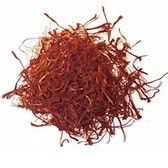
This year we began our menu planning with a couple of themes...lobster would be our featured ingredient and saffron - brought from India by friends of our friends - would be our featured spice. Once I'd plunged deep into the planning phase, I expanded our scope to include truffles, of all things! And this is how it all went...

We started with a simple fonduta - an Italian fondue - with fontina cheese, egg yolks, milk, and shaved black truffle. Then, thus fortified, we began working on the rest of the meal: a truffled lobster risotto, grilled asparagus with saffron aioli, and a simple salad of mesclun with a truffle-infused sherry wine vinagrette.
It was delicious, if I do say so myself, but, of course, we couldn't stop there. A fancy meal deserves to be finished with a fanciful dessert. The chocolate-ier, the better. And so, as our grand finale, we prepared Champurrado's (www.noonessfool.blogspot.com) Chocolate, Walnut and Raspberry Torte, finished with fresh raspberries and whipped cream and served with champagne. It was an unbelievably delicious ending to an incomprehensibly fantastic meal in the company of incredibly wonderful friends.

(The only thing we didn't do that we should have done was to manufacture dark chocolate rose leaves to serve with the torte. Call us lazy. Call us heathens. Just please don't call Champurrado to let him know of our patisserie failings!)

Wednesday, December 07, 2005

Capri!


It's like Christmas come early around here! On Friday, when I ordered my kefir grains, I also ordered a couple of bulk teas - an organic Gunpowder green and an organic whole-leaf Koslanda from Ceylon. Those arrived yesterday. I ordered a few books for work, which I haven't received yet. I ordered some cheese salt and some pH testing strips from www.cheesemaking.com. Those arrived Monday. And then, to top it all off, I ordered a baseball cap from a cheesemaking outfit in Central Massachusetts.

Westfield Farm in Hubbardston has been making all-natural goat and cow milk cheeses since 1971. Chevre is the name of goat cheese - French for goat. Capri is the name for the goat cheese made by the good folks at Westfield Farm. They make between 900 and 1,500 pounds of handcrafted cheeses every week. They are very busy. Their cheeses have won many awards.

I first came across their Capri logs in the dairy section of the local farm market in the town where we used to live. The market sold milk from their own farm cows and cheeses and other dairy products from other local producers. I fell in love with Capri.

Since then I've seen Capri logs around in a few other small-scale dairy stores and some of the larger natural food grocery chains, like Whole Foods. You can also order all of their cheeses online. www.chevre.com.

So, anyway, I decided awhile back that I wanted to do my small part to help publicize the great cheeses of the New England region, so I did a search for small-scale producers that sold t-shirts or baseball caps that I could wear about town. I mean, the Red Sox don't really need my help. You know what I'm saying? And of all the cheesemakers, Westfield Farm was the only one! Which is just as well, since I'm such a fan.

On Friday, at the end of my ordering spree, I went to their website and ordered a cap. $8.99 plus shipping. A good deal. And in the comment section of the order form I wrote a little message about how much I loved their cheese and how I'd like to help advertise for them by wearing the hat around.

And guess what. Yesterday a little box arrived. Spread across the top of the contents was a note written on a big strip of shipping paper in black magic marker, all in capital letters that said:

"[MANCHEGO]-
GLAD YOU LOVE THE CHEESE.
THANK YOU. HERE'S ANOTHER CAP
IN CASE YOU WANT TO MIX IT UP.
WARMLY, BOB@WF"

And sure enough, under the note, not one, but two caps! Isn't that kind?

So, I'll be wearing one or the other all the time now. If you see me on the street, be sure to say, "hello." And in the meantime, be a pal and order some cheeses from Bob! They make great Christmas Gifts. They're great for holiday parties. Great for birthdays. Great just to have around. And best of all, you'll know that you're supporting a nice local guy who is skilled in the art and science of cheesemaking!

What a friend we have in cheeses, indeed!

Monday, December 05, 2005

Manna from Heaven

On Friday, I did something that I don't think I've ever done before. I took a crisp, new $20 bill and put it in an envelope and mailed it to Ohio, to a woman I've never met and to whom I've never even spoken.

Don't send a check, she had written. She doesn't deal with banks.

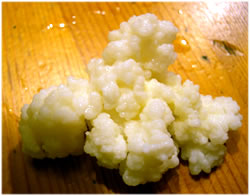
It sounds kind of shady, doesn't it? And it was all to acquire some of the substance shown above. Looks kind of shady, doesn't it?

Well, in case you're not already familiar, gentle reader, I'd like to take this opportunity to acquaint you with kefir grains. Kefir grains are used to produce kefir, a fermented dairy product, which can be made from any kind of milk.

Kefir is sort of like either a thick milk or a thin yogurt in consistency, with a somewhat tangy and refreshing taste, and which is filled with nurtition including more probiotic cultures than yogurt. Consumed regularly, it helps to reestablish the good flora - the good bacteria - that live in your gastrointestinal tract. The good flora then help you digest the rest of what you consume.

Kefir originated in the Caucasus Mountain region. It is thousands of years old. One story of its origin is that it could have been the manna described in the Biblical story of the Exodus - the white stuff that fell in the desert each day to feed the wandering Israelites. A miracle food. Another story is that the Prophet Muhammed gifted it to the shepherds on a trip through the Caucasus Mountains. In which case, it would also be a miracle food.

The word kefir comes from a Turkish word that means "good feeling." It provides complete proteins, minerals, and is particularly rich in the B-complex vitamins. It has been used to help treat people living with AIDS, cancer, chronic fatigue syndrome, depression, ADHD, and all sorts of intestinal disorders. If allowed to ferment long enough, the grains will breakdown all of the lactose in the milk, making kefir the ideal dairy product for the lactose intolerant. People who have consumed it regularly as part of their traditional diet are reported commonly to live to be 100 or more years old.

You can make Kefir at home. All you need is some milk - skim or fat, raw or pasterized, cow, goat or sheep - any kind will do; a clean jar; and some kefir grains. Put the kefir grains in the jar, pour the milk over them, and let them set out on your counter, unrefrigerated, for between 24 and 48 hours. Strain it, start the next batch of milk using the grains, and voila! You can drink your first batch of kefir now or put it in the fridge to slow the fermentation and drink it later. You keep using the grains and over time they multiply. Be forewarned, next year, all my friends and relatives will be getting free kefir grains. And you, too, can become kefir grain farmers.


Of course, you can also buy kefir in some stores - natural food stores and health food stores, including Whole Foods, where I have gotten mine. Once you've acquired the taste, you can really use it in many ways interchangeably with milk or yogurt - in smoothies, shakes, on cereal. You can bake with it. You can even make cheese with it, which is on my list of things to do. The SuperFood fans among you should know that kefir and yogurt are the only two dairy products on The List.

Today, my 1/4 cup of live kefir grains was shipped by priority mail. Within the next two days, it should arrive along with one page of instructions - I don't expect to encounter any surprises - and 6 pages of kefir recipes, fun and trivia. I'm so excited, I can hardy wait. By the end of the week I should be able to report on my first homemade batch of kefir. In the meantime, it's off to the store for more kefir to keep me feeling good until then.

Saturday, December 03, 2005

"A Religious Art"

I won't bore you with what I ate on my first day after the fast. Well, maybe just briefly, if you don't mind terribly...
Breakfast - warm brown rice with a compote of prunes, apricots and cranberries.
Lunch - homemade miso soup using, yes, leftover vegetable broth, and including garlic, onions, tofu, spinach, fresh shitake mushrooms, and, of course, miso paste.
Snacks - a reasonably-sized chunk of young goat gouda and a cup of goat yogurt.
Dinner - We went out to a new-to-me family-owned and -operated Middle Eastern restaurant here in town that serves not only meaty, but also vegetarian and even vegan versions of traditional Middle Eastern food. Everything is made to order. A definite winner! I had a Greek salad, a vegetarian combo platter that included meatless Moussaka, Mujadara, and Spanakopita, served with homemade yogurt. Homemade baklava and Turkish coffee for dessert.

Thanks for your patient indulgence.

Now, on to the intended topic of the day.

This morning I was browsing again through a book that my friend Aral gave me last year, called Not for Bread Alone, which is a collection of writings on "Food, Wine and the Art of Eating." In it is an essay by Judith B. Jones, called "A Religious Art." I'd like to share just a bit of it here with you.

It begins with a quotation, which her husband had once posted for her on their refrigerator door, and which is from the Dialogues of Alfred North Whitehead, who was a prominent Process Theologian:

"Cooking is one of those arts which most requires to be done by persons of a religious nature."

Amen!

And the following are quotations from Ms. Jones, herself:

"Cooking demands attention, patience, and, above all, a respect for the gifts of the earth. It is a form of worship, a way of giving thanks."

"But what about all the time it takes, one is constantly asked - all the shopping, tracking down of choice produce, hours of attention lavished on the preparation of a meal? I guess to many people in our world of modern conveniences, it is irrational. But then most pursuits 'of a religious nature' are irrational."

"...I've been pursuing the root of the word 'religious' and I find that it is thought to spring from religare, meaning to bind, to tie fast, to reconnect. Isn't that exactly what we do when we cook? We connect again to the earth, to the source of our food, and we bind to one another in the sharing of it, in the breaking of bread together, the celebrating of life."

Beautiful words and beautiful thoughts with which to start the weekend! Good eating and Godspeed!

Thursday, December 01, 2005

The End of the Fast and A Hindu Goddess I Could Love

The cleanse is nearly over. And it was good. I just finished my last fast supper - brown rice, steamed broccoli, fresh cherry tomatoes, all mixed together with garlic and crushed red pepper. Colorful and delicious. Although next time, I think I'd probably add some tofu.

It's funny what I've come to crave over the last five days. I thought I'd most miss cheese, bread and wine. I did miss cheese. There is a hunk of raw goats' milk gouda in my refrigerator calling out my name. It's been whispering to me with increasing volume and intensity all week long. I also developed a longing for tofu, which, frankly, I haven't bought for years. It even sounds good plain. The last five days I've begun to become somewhat pleasantly accustomed to utter simplicity. Somewhat.

What has been most interesting has been watching how my perspective on the fast itself has changed through the course of the week. For instance, I started calling it a "fast" rather than a "cleanse." It began to take on more and more spiritual significance and less and less physical importance.

In the beginning, rice, veggies and fruit seemed like such a terrible deprivation. By day three, rice seemed almost like a gift from the gods for which I could hardly wait. I was tiring of vegetables. Day four - broth day - had me appreciating vegetables again. This morning, day five, I was unbelievably grateful for my odd little breakfast, which consisted of mashed banana and brown rice. I could literally think of nothing more delicious. I could imagine eating it every morning of my life with utter joy and exuberant gratitude.

I never felt hungry. I always felt sated. But I did spend a great deal of time thinking about food - even more than usual, I would say. In part I've been thinking very carefully about the foods I most want to eat in breaking the fast. I want to be deliberate about it. I want to choose wisely - not necessarily always healthily, but wisely - sometimes decadently. I mean, are donuts really worth the cost of 5 days of fasting? No. But goat gouda is.

I read a few books on faith this week - Anne Lamott's Plan B and Sharon Salzberg's Faith. I'm sure that added to the spiritual focus of the week - that and my deepening awareness of Advent. Anyway, to get to the Hindu goddess part...

Sharon Salzberg wrote about the ishta dev - the personal deity to which one offers one's heart. You choose a god or goddess based on the qualities you most want to emulate. She says for her, if she were to choose an ishta dev, it would be Lady Liberty, as in the Statue of. I might have said Jesus or the Buddha. But that's another story.

It caught my attention for some reason. Perhaps because all the fasting was making me think of Gandhi whose autobiography kept catching my eye from my office bookshelf. And so, to indulge my curiosity, I started searching the web for Hindu deities. Surely, surely, there must be one for me...

And eureka! I found her! Annapurna, pictured above, is the Hindu goddess of food and cooking. She is the goddess of abundance and nourishment. She is said to have the power to supply food to an unlimited number of people - to everyone who hungers. An incarnation of Parvati, the wife of Shiva, she is pictured above giving food to Shiva that he might have the energy to attain enlightenment. She "symbolizes the divine aspect of nourishing care. The cook provides his guests with the energy to best follow their destiny. When food is cooked with a spirit of holiness, it becomes alchemy." (Compliments of Christine Gruenwald and Peter Marchand at www.sanatansociety.org)

And that for me, my friends, sums up pretty nicely what it's all about.

Monday, November 28, 2005

The Post Thanksgiving Cleanse


So, I love Thanksgiving. I really do! Once - or in my case - twice a year, I love to look down at a plate filled with turkey, mashed potatoes, gravy, stuffing, sweet potatoes, squash, cranberry sauce, rolls, corn bread, creamed onions, and the occasional green vegetable - as in broccoli cheese casserole or green beans in mushrooms soup with fried onions on top.

But two days a row of this stuff really does me in. It almost makes me dizzy, like this picture! And I didn't even have much pie!

Actually, some of the traditional Thanksgiving fare is pretty healthy. A moderately-sized portion of turkey breast (as much as I'd prefer the dark meat), homemade cranberry sauce that's light on the sweetener, sweet potatoes or squash sans butter and added sweetener, and something green sans cream of mushroom soup or velveeta (as much as we love the taste of both!) - well, THAT would be a plate of SuperFoods.

I haven't posted about SuperFoods yet, but I've certainly been meaning to, and now is as good a time as any. The SuperFoods are 14 foods (and related foods) that Dr. Stephen Pratt has written about in his book, SuperFoodsRx, foods that contain all of the necessary micronutrients for good health.

You can learn more about SuperFoods and their benefits at www.superfoodsrx.com, but here is the list:

Beans, Blueberries, Broccoli, Oats, Oranges, Pumpkin, Wild Salmon, Soy, Spinach, Tea, Tomatoes, Turkey, Walnuts, and Yogurt.

I highly recommend the book. It's been my food bible for a couple of years. I bought it. I read it. I loved it. I started eating as many SuperFoods as I could lay my hands on. I told my sister about it when she was visiting. She liked the sound of it. She started reading it. She took my book, handed me $20, and told me to buy myself another one. And I did.

Anyway, mashed potatoes...not a SuperFood. Mom's traditional whitebread stuffing...not a SuperFood. No beans, no tomatoes, no yogurt, no salmon, no soy, and not enough of everything else. See? After two Thanksgiving dinners, I'm way off the mark.

So yesterday I started a five-day cleanse. Day one: Brown rice and all the organic fruits and vegetables I could eat. No dairy. No nuts. No oils. No salt. No sugar. No processed foods. No fats.

I did okay on day one, except that my larder was full of mostly conventionally grown produce. And I cheated a little, not meaning to, but thinking I was being clever, and made a dressing for my spinach salad out of tahini and lemon juice. Oil. Oops. Dinner was an ample bowl of rice with steamed broccoli, onions, and carrots. I did get a smacking headache in the afternoon, which I think was mostly due to the caffeine withdrawl.

Day two: Only organic fruits and vegetables. I went to the store to fill my larder. Breakfast was homemade apple sauce from the last of the summer farm apples. Lunch was a big mess o' Swiss Chard, steamed, mixed with a little garlic and topped with some organic herbed white wine vinegar. I think I'll have a little afternoon fruit snack and then a big bowl of salad for dinner.

I have been cheating just a little today. I decided to drink a kind of green tea - Kuki-cha - which is made from the roasted twigs of the tea plant. It's low in caffeine, but just enough to forestall a headache.

Day Three is the same as day two. Day Four will be the hardest - only broth from an organic veggie soup that I have to make between now and then. Just broth. Nothing but broth. Day Five, which will come none too soon, I'll be back to brown rice, fruits and veggies. The hardest part of days three through five will be that I'll be away from home most of the time and for most of my meals and so will have to really plan ahead and take enough to fill me up. But I think I am up to the challenge.

I expect to feel fabulous by Friday morning! I'll let you know how it goes...

In the meantime, enjoy eating all the things that I can't eat...and just for fun, let me know what food you think you'd miss the most if you were doing a five-day cleanse.

Sunday, November 27, 2005

A Quick Thanksgiving Recap

Well, Thanksgivings one and two are over and done. But before we leave them entirely in the compost pile, I just have to pay tribute to my brother-in-law, the host of our family dinner on Friday. He outdid himself this year. Look what he did with the table!

And imagine my delight when we walked in to discover a cheese appetizer station - and the delight of others at the chocolate and petit four station!

Bravo! And Encore! I'm already looking forward to next year's feast!